Planning ahead can make all the difference when preparing for an interpreting project, helping to ensure a successful experience, rather than a last-minute scramble.
Our dedicated project and account managers coordinate interpreting assignments every day – meetings, conferences, events, you name it. After speaking with our team about what goes on behind the scenes to make these projects run smoothly, their biggest piece of advice was simple: start planning as early as possible.
Remember, interpreting and translation are two distinct services. Interpreting focuses on spoken and signed communication in real time, while translation involves written content. If your project requires both, we recommend discussing this early so the right resources can be arranged.
To help you get started, in this blog we've broken the process down into five key steps:
- Identify the type of interpreting you need
- Book as early as possible
- Share the key project details
- Send supporting materials early
- Picture the day of the assignment
Prefer a quick overview?
Watch our short video below for a summary of the five key steps to preparing for an interpreting project, then keep reading for more detailed guidance.
Here's what to consider before your next interpreting project to help ensure everything runs smoothly.

1. Identify the type of interpreting you need
You’ll first need to understand the type of interpreting you need.
However, choosing the right interpreting service can be difficult if you're unfamiliar with the different options available.
One of the first things our account managers can help clients with is identifying the most suitable interpreting service for their project. Whether it’s simultaneous interpreting, consecutive interpreting, whispered interpreting, video remote interpreting (VRI) or over the phone(OPI), our team is happy to talk through them.
The most common forms are highlighted in the table below:
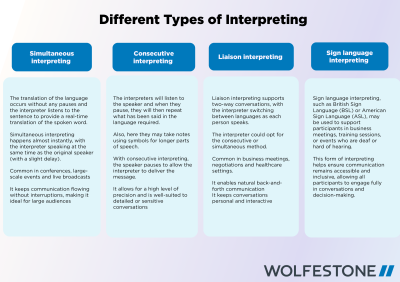
Note: remember to consider the event duration
Many clients are surprised to learn that longer simultaneous assignments often require two interpreters rather than one. This is because interpreters regularly alternate throughout the session to maintain concentration and quality.
While an hour-long meeting may seem manageable, sustained simultaneous interpreting places demands on the interpreter, making adequate staffing an important consideration during the planning stage.
2. Book as early as possible
Many interpreters work on a freelance basis and often receive multiple booking requests. So, just because an interpreter is available when a quote is issued doesn't mean they will still be available several days later.
Delaying approval can sometimes mean the ideal interpreter is no longer available, requiring additional sourcing or alternative solutions.
For this reason, we recommend:
- Requesting quotes as early as possible
- Confirming bookings promptly once approved
- Allowing additional time for specialist subject matter or rare language combinations
In-person assignments need additional notice
For face-to-face interpreting events, travel arrangements, venue logistics and interpreter availability all need to be coordinated before the assignment can take place. Our team recommends a minimum of 72 hours' notice for in-person interpreting assignments, although longer lead times are always preferable.
That said, we know that not every project comes with plenty of notice. If you have an urgent requirement, our team will always do everything possible to source the right interpreter and support your project within the time available.
It's also worth noting that in-person interpreting may be more expensive than remote alternatives due to travel and logistical requirements. However, for certain meetings, events and sensitive discussions, many organisations feel the added level of engagement and interaction is worth the investment.
3. Share the key project details
The more information you provide at the start, the easier it is to source the right interpreter and deliver the highest-quality service.
At a minimum, you should aim to provide:
- Languages required
- Date and time
- Expected duration, location or platform
- Whether the assignment is remote or in person
Additional information such as audience size, event objectives and speaker details can also help us find the most suitable linguist.
4. Send supporting materials early
Many people assume that interpreters can simply arrive and begin working without preparation. However, things like your presentation slides, reports, speaker notes, agendas and background materials, all allow interpreters to familiarise themselves with terminology and industry-specific language ahead of time.
As one of our account managers explained:
"Presentation materials are incredibly important. We always encourage clients to share slides, agendas and supporting documents as soon as possible. Ideally, interpreters should receive materials at least a week in advance, especially for longer assignments where there may be hours of content to review and prepare for."
While any advance notice is helpful, one week before the event should be considered the minimum target whenever materials are available (the sooner information is shared, the better prepared the interpreter can be!)
5. Picture the day of the assignment
Once the booking is confirmed and materials have been shared, it's worth taking a moment to think about how the assignment will run on the day itself.
For speakers and presenters, communication style can have a significant impact on interpreting quality. While professional interpreters are trained to work in fast-paced environments, speaking too quickly can make their job considerably more challenging.
Our account managers recommend that presenters:
- Speak clearly and at a steady pace
- Avoid rushing through presentations
- And, allow time for questions and discussion
It is also helpful to let your language services provider know if any speakers have particularly strong regional accents. This gives interpreters the opportunity to prepare and familiarise themselves with any relevant materials beforehand.
Alongside speaker preparation, be sure to flag any logistical requirements early. Whether your project requires simultaneous interpreting equipment, headsets, remote interpreting platforms or venue-specific arrangements, providing these details in advance helps us coordinate the right solution and ensure everything runs smoothly on the day.
Also, depending on the nature of your event, interpreting can also be combined with live captioning, helping to support multilingual audiences while improving accessibility for attendees who prefer to follow along with on-screen text.
How Wolfestone can help
Successful interpreting projects come down to three things: early planning, clear communication and giving interpreters the information they need to prepare. From there, we’ll handle the rest. By following these five steps, you’ll be well positioned to get the most from your interpreting service.
Whether you're planning a small meeting, a large conference or a complex multilingual project, our team is here to help and support you every step of the way. With dedicated account management and access to a network of professional interpreters, we make it easier to deliver successful interpreting projects.
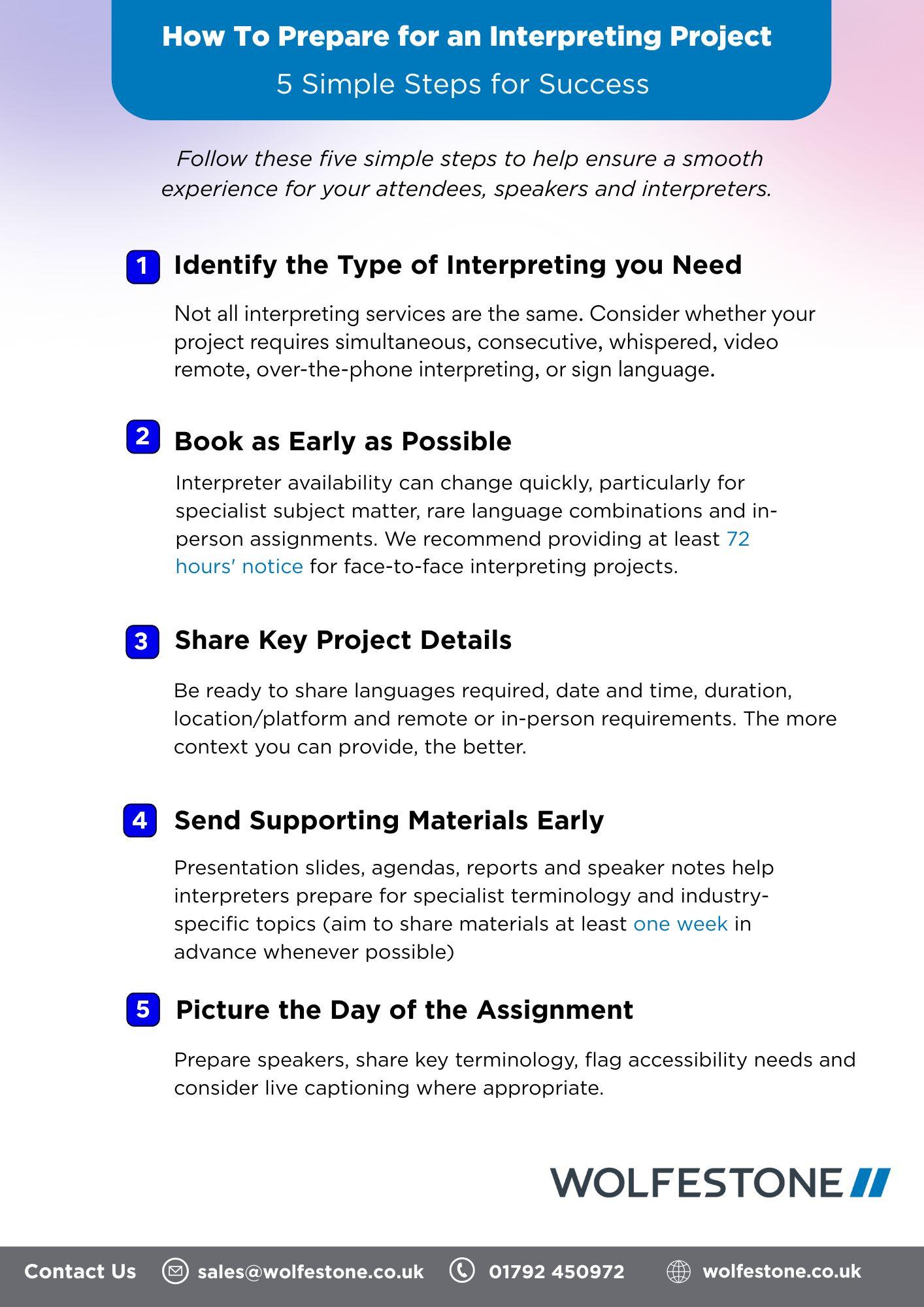
Need a quick recap? We've summarised the key points into a handy one-page guide below.
Isabelle writes about translation, localisation and multilingual language solutions for Wolfestone. She holds a Master's degree in Journalism, Media and Communications from Cardiff University School of Journalism, and enjoys exploring how language, culture and technology come together to help brands connect confidently with global audiences.