𝘈𝘱𝘱𝘳𝘰𝘹 𝘳𝘦𝘢𝘥 𝘵𝘪𝘮𝘦: 4 𝘮𝘪𝘯𝘴🕒
2025 has shown us just how fast the world of translation and localisation is shifting, with AI tools continuing to transform, global content accelerating, and clients now expecting faster, better and culturally sensitive content.
However, it’s also smart to ask where the language-services industry is headed next. Which shifts will define the coming year, and how can we help maximise those changes confidently?
In this blog, we’ll explore the key trend predictions set to shape translation and localisation in 2026.
Market growth and continued expansion
It’s a positive start to the year, with demand for language services expected to stay consistently strong.
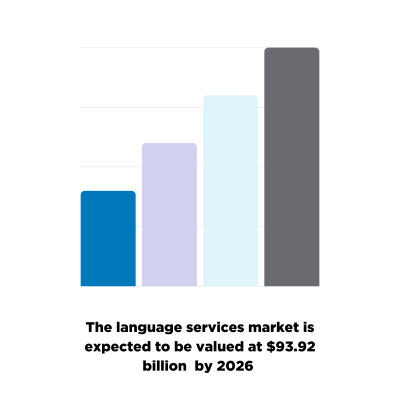
The global language-services market is set for continued expansion across translation, localisation, interpreting and subtitling, and according to one recent report, the market was valued at USD 88.77 billion in 2025 and is projected to reach USD 93.92 billion in 2026.
So, as more companies expand into new markets, create digital content and launch multilingual platforms, it’s no surprise that the need for professional translation, localisation and language services naturally continues to rise.
AI and hybrid translation workflows
AI and hybrid translation workflows are quickly becoming a go-too. One recent market report notes that many language-service providers now rely on machine translation (MT) tools or a mix of human and machine (MT and post-editing).
Over the years, Machine Translation (MT) has evolved from basic outputs into highly trained systems, capable of handling large volumes of content at impressive speeds. But the success here happens when MT is paired with human post-editing (MTPE).
It’s got both the speed and scalability, without compromising on quality, which is exactly why the hybrid model has become so popular…
Modern businesses face all sorts of demands, like needing more content than ever, shorter turnaround expectations, budget consciousness and the constant pressure to go global quickly.
Why will it continue to dominate in 2026?
Because AI keeps improving, but it still can’t replicate cultural insight, creativity, empathy or specific judgement, and businesses know that.
GenAI and LLMs
Heading into 2026, GenAI and Large Language Models (LLMs) are impacting translation by moving beyond adaptation into full content generation. Now, instead of waiting for a source text, LLMs can now create a first draft multilingual copy – think product descriptions, FAQs, support scripts or marketing lines.
What does this mean in terms of the future?
- Faster multilingual content creation, since teams can generate draft content in several languages at once, speeding up global launches.
- Smarter adaptation: LLMs quickly adjust tone and style, giving linguists stronger starting points.
- Better translation refinement: GenAI can polish MT output, enforce terminology and propose more natural phrasing before human review.
- Improved consistency: LLMs maintain coherence across paragraphs and long-form content, something older MT systems actually struggled with!
The result: GenAI continues to become a powerful drafting and quality-enhancing tool, not a replacement for human localisation, just a way to produce better multilingual content faster with a translation partner.
Localisation and the growing demand for rich content localisation
As businesses continue to discuss plans to expand globally, localisation is increasingly viewed as a growth accelerator if you want to succeed properly, plus gain a competitive advantage.
Research tells us that the global localisation translation service market size was USD 2.90 Billion in 2024, and for 2025 it was predicted to touch USD 2.96 Billion.
Strong growth in localisation demand is also driven by digital content, regulatory compliance and the need for culturally adapted user experiences.
With the rise of streaming platforms, e-learning, and, in case you didn’t notice, the huge increase of podcasts this year in particular, global video marketing means more demand than ever for translation and localisation beyond text. Businesses really need to consider subtitles, dubbing, voice overs and multilingual audio if they want to comply.
According to market analyses, subtitling and captioning are among the fastest-growing segments in language services.
So, organisations with global audiences won’t just need website text or documents translated, they’ll be looking towards full multimedia localisation.
Regulated industries, compliance and certified translation
While AI and hybrid workflows continue to take off, certain sectors simply can’t rely on automation alone.
Legal, medical, financial and government-facing content will remain firmly dependent on human-led, certified and highly accurate translation.
Despite automation trends, the demand for high-quality, specialist translations from translation companies remain strong, since these areas involve zero margin for error and a mistranslated clause, dosage, or regulation can have major consequences.
Heading into 2026, with regulations changing and documentation requirements tightening, organisations will need translations that are officially recognised.
This can include legal documents, court materials, regulatory filings, medical reports, compliance documentation or immigration and visa paperwork.
Why is this a key prediction?
Even with AI becoming more capable, regulated industries will continue demanding translations backed by human expertise, formal approval and documented accuracy. Certified translation, in particular, is expected to grow in importance as more authorities in the UK and abroad require proof that a translation is true, complete and legally valid.
If you’re unsure what certified translation involves, how it differs from standard translation, or when you might need one, you can read our dedicated guide: Certified Document Translation: What It Is and When You Need It.
Need localisation or translation support?
If you’d like to talk about how to localise your content, scale multilingual operations or translate essential documents going into the new year, we’d love to support.
Contact us today for a free quote, test piece or consultation.
Isabelle writes about translation, localisation and multilingual language solutions for Wolfestone. She holds a Master's degree in Journalism, Media and Communications from Cardiff University School of Journalism, and enjoys exploring how language, culture and technology come together to help brands connect confidently with global audiences.